Advanced NMR Spectroscopy: verschil tussen versies
| (28 tussenliggende versies door 8 gebruikers niet weergegeven) | |||
| Regel 1: | Regel 1: | ||
[[Categorie:Machemie]] | [[Categorie:Machemie]] | ||
= | =Course information= | ||
Advanced NMR Spectroscopy | In 2025-2026, the course Advanced NMR Spectroscopy consists of three parts: Part 1 General NMR theory (Prof. Wim De Borggraeve); Part 2 Applications of NMR (with guest lectures from Prof. Tatjana Parac-Vogt and Prof. Dimitrios Sakellariou and Dr. Gert Steurs); Part 3 Exercises (Dr. Gert Steurs). There is also a reading assignment from Prof. Vogt (scientific article about an application of NMR), with exam questions about the article. The exam takes 3 hours and this will be barely enough, so do not waste too much time on hard questions. | ||
== | |||
==Exam questions== | |||
===13 januari 2025=== | |||
Vogt (ppt + paper + SI on pc) | |||
*Paper: Monitoring the interaction of alpha-synuclein with calcium ions through exclusively heteronuclear NMR experiments. | |||
#Draw the structure of aspartate and indicate C', C(alpha), C(bèta) and C(gamma). Use the spectra from the paper to derive the chemical shifts of these carbons. Which experiments were used to study the interactions of the protein with Ca2+? | |||
#Explain the role of proline and tyrosine in the calcium-protein binding. Why are the signals of these amino acids the ones that are most changed by this interaction? | |||
Sakellariou (ppt on pc) | |||
#What is the main reason for line-broadening in solid state NMR and which technique is used to avoid this issue? Can nuclei with I = 1 be determined with MQMAS? | |||
De Borggraeve | |||
*C-H Heteronuclear pulse program is given with: d1, p1 (= 90° on H), d2, p2 (on C). The delay d1 is 5*T1 so that all spins are in equilibrium at p1. The delay d2 is given by 1/J(IS). The experiment is carried out for CHCl3, with offsets of 0 Hz for H and C. | |||
#With which experiment(s) can we determine d2? | |||
#Assume now that we know d2. When p2 < 90° the spectrum contains one absorptive peak up and one absorptive peak down, when p2 > 90° these peaks get inverted. When p2 = 90°, the peaks disappear. Prove this with product operators. | |||
Steurs | |||
*Cyrene (Exercise 2.6 but without proton-decoupled C-NMR spectrum): explain the type of experiments used (name + what info can you get from it), process all spectra and assign all H- and C-signals (no need to explain) | |||
#How many imaginary data points are there in (file number)? | |||
#How many times did different values of t1 get recorded in (file number)? (not sure about this question) | |||
#How many times did the spectrometer run through the pulse sequence in (file number)? | |||
*How the spectrometer works: given 5 definitions, link 4 of them to: field-freq lock, shimming, matching&tuning, receiver gain | |||
*BONUS QUESTION: What is the spin system of F2C=C=CH2 knowing that the spin system of F2C=CH2 is AA'XX'? | |||
*BONUS QUESTION: Calculate d2 (in milliseconds) from the exercise of De Borggraeve using provided data sets (I think you had to measure J(C-H) from the C-NMR spectrum -> d2 = 1/2J(C-H)) | |||
===16 januari 2023=== | |||
====Vogt==== | |||
#Why do we label proteins with 2H? | |||
#In the paper, the binding of lifitegrast to the receptor binding domain (RBD) of SARS Cov-2 S-protein gets proven through STD and HSQC. Explain this and refer to the correct spectra. | |||
====De Borggraeve==== | |||
Heteronuclear pulse program is given with: d1, 90° p1 and d2 on spin I. And 90° p2 on spin S. The period of p1 gets various different time intervals, while the period of p2 is given by 1/JIS. | |||
#How do we calculate T2? How do we find this in the spectrum? | |||
#What is the result of the product operators of this pulse sequence where T2=0, so p2 disappears. | |||
#When p2<π/2 there is an anti-phase spectrum, when p2>π/2 this anti-phase gets inverted. When p2=π/2, the peaks disappear. Prove this with product operators. The reference and receiver frequency is set for CHCl3. What is the consequence for the offset for the proton of CHCl3? | |||
====Steurs==== | |||
Galantamine (Exercise 2.5) | |||
===18 januari 2022=== | |||
Ingekorte examenduur tot 3u omwille van corona. Grootste moeilijkheid examen: tijdsdruk! (Zelfs extra tijd gekregen wegens tijdsnood bij alle studenten) | |||
====Vogt==== | |||
#Waarom volledig gedeutereerd? | |||
#??? | |||
====De Borggraeve==== | |||
#Product operators | |||
====Oefeningen==== | |||
#p-Menth-8-en-3-ol (denk ik) met keuze uit 2 conformaties. | |||
===9 januari 2021=== | |||
Ingekorte examenduur tot 3u omwille van corona. Grootste moeilijkheid examen: tijdsdruk! | |||
====Vogt==== | |||
#Waarom worden die specifieke nuclei gebruikt in de paper voor de NMR? | |||
#??? | |||
====De Borggraeve==== | |||
#De evolutie van een antifase term onder free evolution. Hoe ziet het verkregen signaal eruit? Hoe zou je zo'n term genereren? | |||
====Oefeningen==== | |||
#Een cyclohexaanring met een OH-groep op en een dubbele binding aan vast. | |||
===20 januari 2017 voormiddag=== | ===20 januari 2017 voormiddag=== | ||
====Vogt==== | ====Vogt==== | ||
| Regel 15: | Regel 77: | ||
===8 januari 2016=== | ===8 januari 2016=== | ||
[[Media:Examen Advanced NMR 2016-page-001.jpg]] | [[Media:Examen Advanced NMR 2016-page-001.jpg]] | ||
[[Media:Examen Advanced NMR 2016-page-002.jpg]] | [[Media:Examen Advanced NMR 2016-page-002.jpg]] | ||
[[Media:Examen Advanced NMR 2016-page-003.jpg]] | [[Media:Examen Advanced NMR 2016-page-003.jpg]] | ||
| Regel 35: | Regel 96: | ||
====Van Der Auweraer==== | ====Van Der Auweraer==== | ||
# | # | ||
#*Bereken de pi bijdrage in | #*Bereken de pi bijdrage in een 4J27 koppeling en in een 5J37 koppeling in een cycloheptatrieen (tekening met hoeken gegeven) | ||
#*Gegeven: vicinale koppelingsconstante is 2,8 Hz, en 2 structuren (1 met de 2 H's op een zesring en 1 met de 2 H's op een vierring). Met welke van de 2 structuren komt deze koppelingsconstante het beste overeen? | #*Gegeven: vicinale koppelingsconstante is 2,8 Hz, en 2 structuren (1 met de 2 H's op een zesring en 1 met de 2 H's op een vierring). Met welke van de 2 structuren komt deze koppelingsconstante het beste overeen? | ||
#Naar welke spin golffunctie evolueert een AX-systeem als er de Hartmann Hahn voorwaarden op toegepast worden? | #Naar welke spin golffunctie evolueert een AX-systeem als er de Hartmann Hahn voorwaarden op toegepast worden? | ||
| Regel 41: | Regel 102: | ||
#*Hoe evolueert de magnetisatie van een 13C in een CH-groep in een assenstelsel dat roteert met de Larmorfrequentie van een 13C-kern zonder koppeling met 1H? | #*Hoe evolueert de magnetisatie van een 13C in een CH-groep in een assenstelsel dat roteert met de Larmorfrequentie van een 13C-kern zonder koppeling met 1H? | ||
#*Waarom volstaat het niet om na de pi/2-puls en evolutieperiode 1/J het FID te detecteren? | #*Waarom volstaat het niet om na de pi/2-puls en evolutieperiode 1/J het FID te detecteren? | ||
====De Borggraeve (oefeningen en alleen schriftelijk)==== | ====De Borggraeve (oefeningen en alleen schriftelijk)==== | ||
#ABX spectrum van de 2e orde | #ABX spectrum van de 2e orde | ||
| Regel 55: | Regel 117: | ||
#Naar welke spin golffuncties gaat een AX-systeem als er de Hartmann Hahn voorwaarden op toegepast worden? | #Naar welke spin golffuncties gaat een AX-systeem als er de Hartmann Hahn voorwaarden op toegepast worden? | ||
#Puls sequentie: pi/2x' t1/2 piy' t1/2 FID. Toepassen op een AX systeem met vx0= va0 + 2pi Jax en t1/2=1/8piJax. Bespreek en leg uit hoe het spectrum er nadien gaat uit zien. | #Puls sequentie: pi/2x' t1/2 piy' t1/2 FID. Toepassen op een AX systeem met vx0= va0 + 2pi Jax en t1/2=1/8piJax. Bespreek en leg uit hoe het spectrum er nadien gaat uit zien. | ||
====De Borggraeve (oefeningen en alleen schriftelijk) | ====De Borggraeve (oefeningen en alleen schriftelijk)==== | ||
#ABX spectrum van de 2e orde | #ABX spectrum van de 2e orde | ||
#Uitzoeken welke configuratie een bepaald molecule heeft adhv spectra. | #Uitzoeken welke configuratie een bepaald molecule heeft adhv spectra. | ||
Huidige versie van 25 jan 2026 om 22:10
Course information
In 2025-2026, the course Advanced NMR Spectroscopy consists of three parts: Part 1 General NMR theory (Prof. Wim De Borggraeve); Part 2 Applications of NMR (with guest lectures from Prof. Tatjana Parac-Vogt and Prof. Dimitrios Sakellariou and Dr. Gert Steurs); Part 3 Exercises (Dr. Gert Steurs). There is also a reading assignment from Prof. Vogt (scientific article about an application of NMR), with exam questions about the article. The exam takes 3 hours and this will be barely enough, so do not waste too much time on hard questions.
Exam questions
13 januari 2025
Vogt (ppt + paper + SI on pc)
- Paper: Monitoring the interaction of alpha-synuclein with calcium ions through exclusively heteronuclear NMR experiments.
- Draw the structure of aspartate and indicate C', C(alpha), C(bèta) and C(gamma). Use the spectra from the paper to derive the chemical shifts of these carbons. Which experiments were used to study the interactions of the protein with Ca2+?
- Explain the role of proline and tyrosine in the calcium-protein binding. Why are the signals of these amino acids the ones that are most changed by this interaction?
Sakellariou (ppt on pc)
- What is the main reason for line-broadening in solid state NMR and which technique is used to avoid this issue? Can nuclei with I = 1 be determined with MQMAS?
De Borggraeve
- C-H Heteronuclear pulse program is given with: d1, p1 (= 90° on H), d2, p2 (on C). The delay d1 is 5*T1 so that all spins are in equilibrium at p1. The delay d2 is given by 1/J(IS). The experiment is carried out for CHCl3, with offsets of 0 Hz for H and C.
- With which experiment(s) can we determine d2?
- Assume now that we know d2. When p2 < 90° the spectrum contains one absorptive peak up and one absorptive peak down, when p2 > 90° these peaks get inverted. When p2 = 90°, the peaks disappear. Prove this with product operators.
Steurs
- Cyrene (Exercise 2.6 but without proton-decoupled C-NMR spectrum): explain the type of experiments used (name + what info can you get from it), process all spectra and assign all H- and C-signals (no need to explain)
- How many imaginary data points are there in (file number)?
- How many times did different values of t1 get recorded in (file number)? (not sure about this question)
- How many times did the spectrometer run through the pulse sequence in (file number)?
- How the spectrometer works: given 5 definitions, link 4 of them to: field-freq lock, shimming, matching&tuning, receiver gain
- BONUS QUESTION: What is the spin system of F2C=C=CH2 knowing that the spin system of F2C=CH2 is AA'XX'?
- BONUS QUESTION: Calculate d2 (in milliseconds) from the exercise of De Borggraeve using provided data sets (I think you had to measure J(C-H) from the C-NMR spectrum -> d2 = 1/2J(C-H))
16 januari 2023
Vogt
- Why do we label proteins with 2H?
- In the paper, the binding of lifitegrast to the receptor binding domain (RBD) of SARS Cov-2 S-protein gets proven through STD and HSQC. Explain this and refer to the correct spectra.
De Borggraeve
Heteronuclear pulse program is given with: d1, 90° p1 and d2 on spin I. And 90° p2 on spin S. The period of p1 gets various different time intervals, while the period of p2 is given by 1/JIS.
- How do we calculate T2? How do we find this in the spectrum?
- What is the result of the product operators of this pulse sequence where T2=0, so p2 disappears.
- When p2<π/2 there is an anti-phase spectrum, when p2>π/2 this anti-phase gets inverted. When p2=π/2, the peaks disappear. Prove this with product operators. The reference and receiver frequency is set for CHCl3. What is the consequence for the offset for the proton of CHCl3?
Steurs
Galantamine (Exercise 2.5)
18 januari 2022
Ingekorte examenduur tot 3u omwille van corona. Grootste moeilijkheid examen: tijdsdruk! (Zelfs extra tijd gekregen wegens tijdsnood bij alle studenten)
Vogt
- Waarom volledig gedeutereerd?
- ???
De Borggraeve
- Product operators
Oefeningen
- p-Menth-8-en-3-ol (denk ik) met keuze uit 2 conformaties.
9 januari 2021
Ingekorte examenduur tot 3u omwille van corona. Grootste moeilijkheid examen: tijdsdruk!
Vogt
- Waarom worden die specifieke nuclei gebruikt in de paper voor de NMR?
- ???
De Borggraeve
- De evolutie van een antifase term onder free evolution. Hoe ziet het verkregen signaal eruit? Hoe zou je zo'n term genereren?
Oefeningen
- Een cyclohexaanring met een OH-groep op en een dubbele binding aan vast.
20 januari 2017 voormiddag
Vogt
Paper: Direct NMR detection of bifurcated hydrogen bonding in the alpha helix N-caps of ankyrin repeat protein.
- Welk NMR experiment is gebruikt om H-binding tussen His en Thr residues te detecteren? Teken H-bindingen in NRRC tussen His en Thr en geef koppelingsconstante.
- Leg het effect van T44V mutatie uit op de geometrie van H-bindingen in NRRC proteine.
Van Der Auweraer
vraag 3,4 en 5 van 2015
De Borggraeve
- oefening 1 van 2015
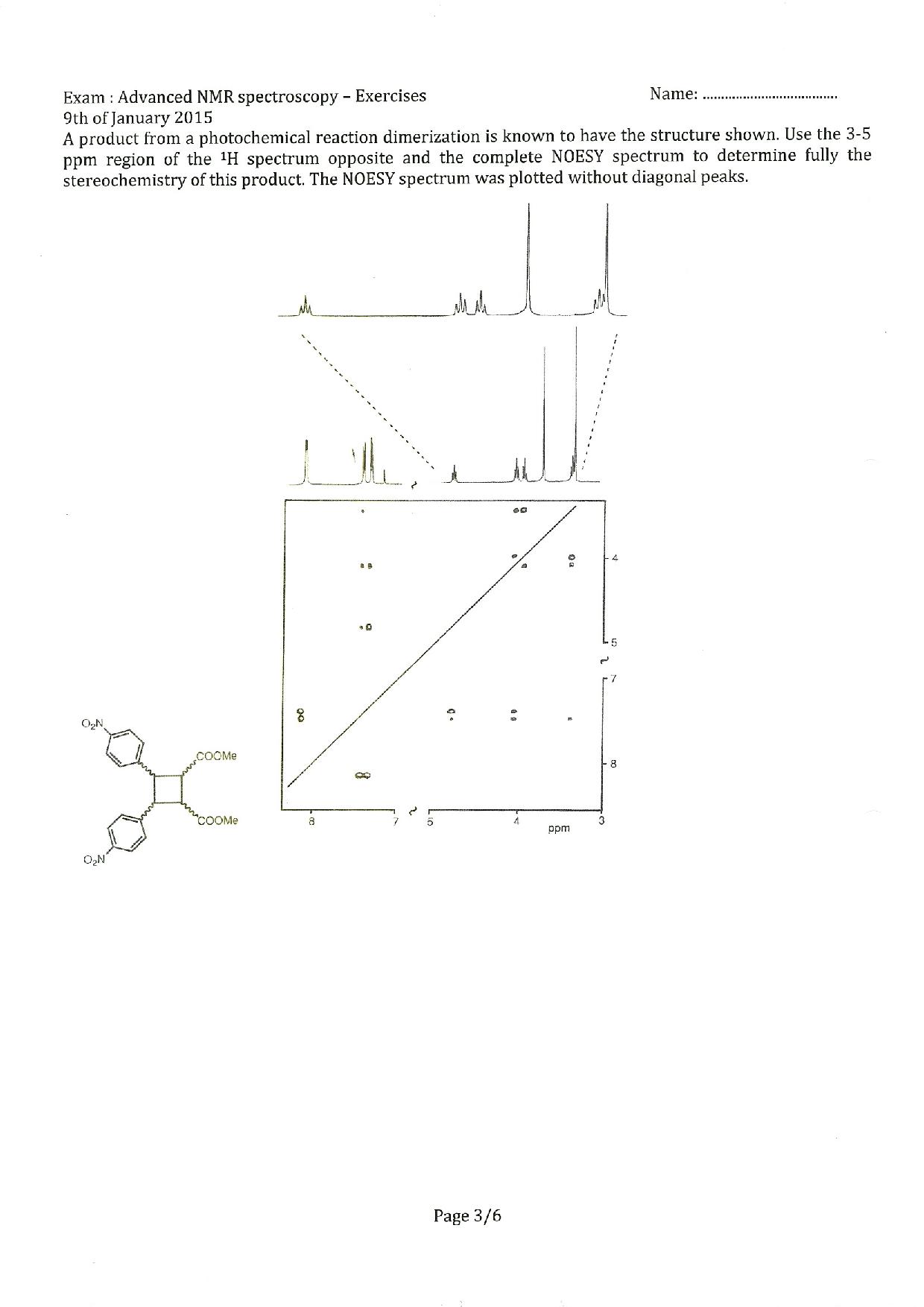
- juiste isomeer bepalen via NOE en pieken toekennen
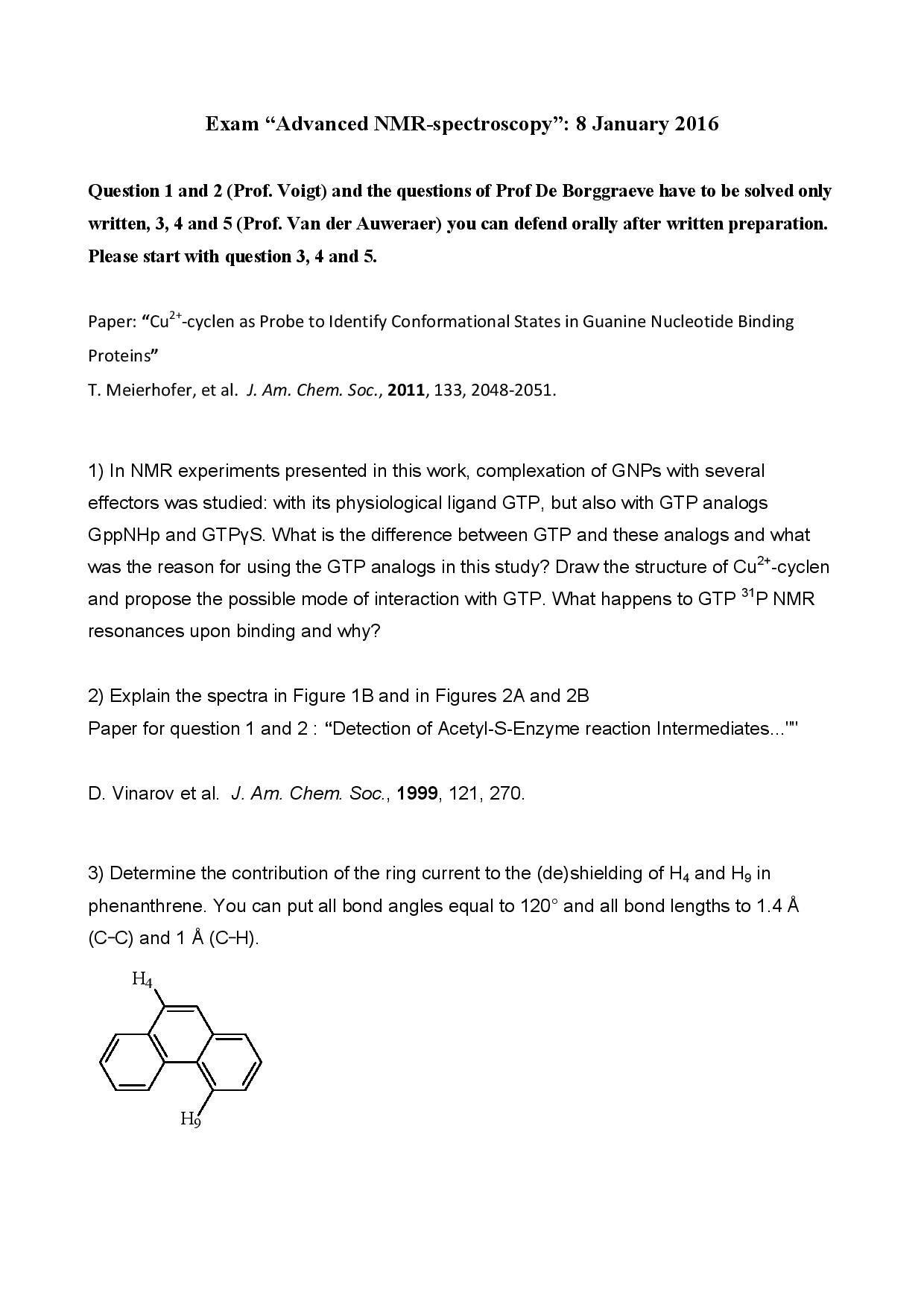
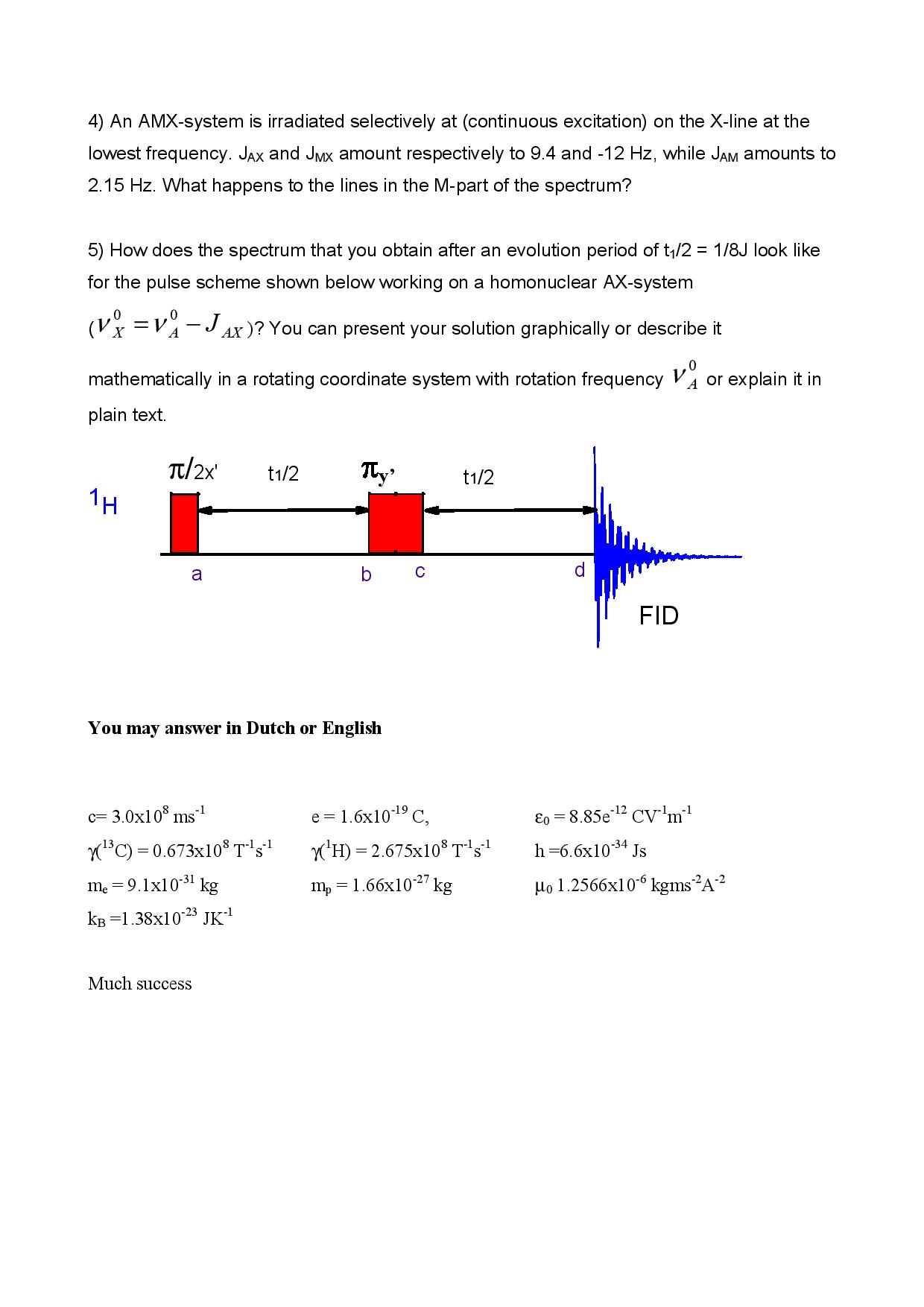
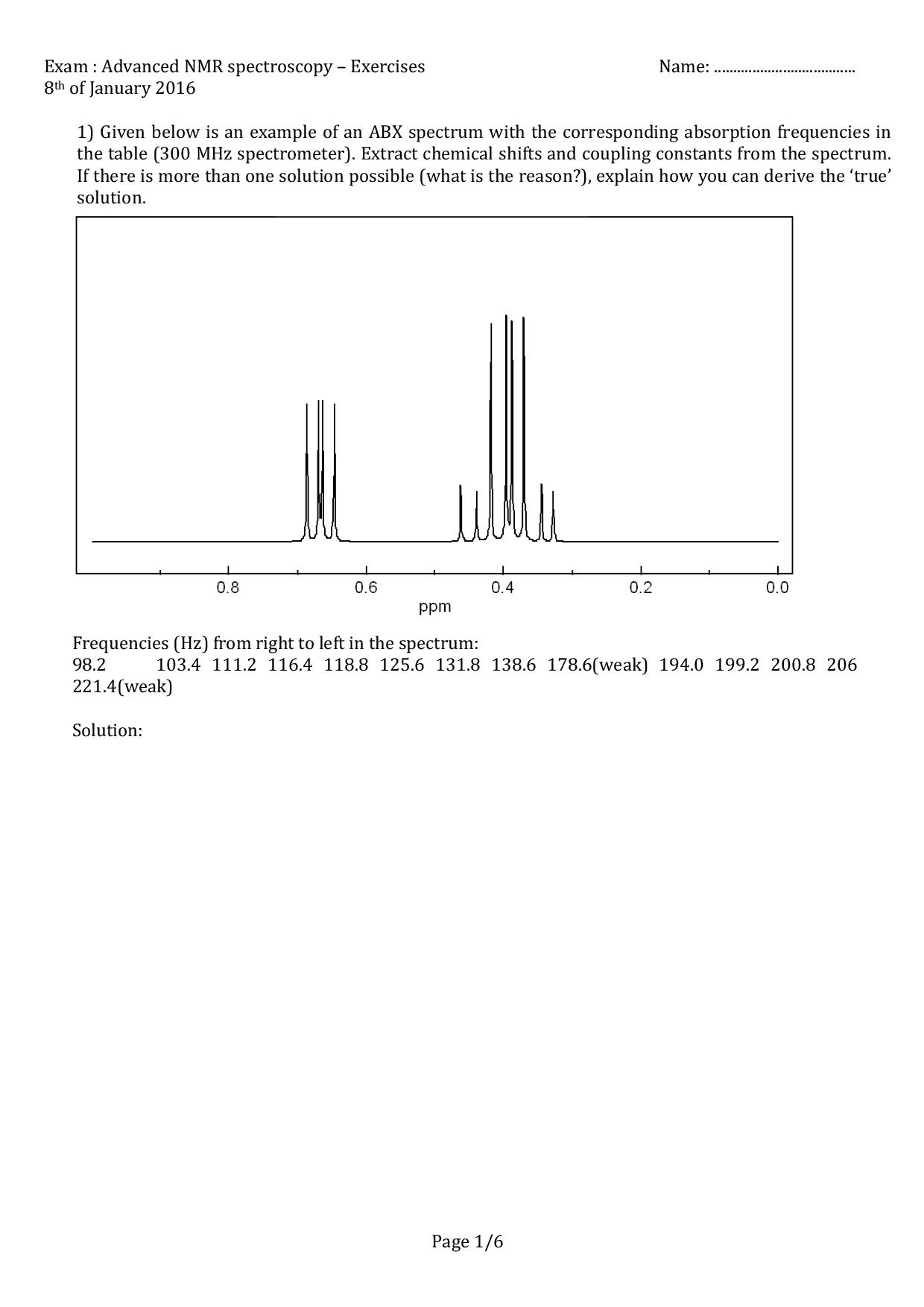
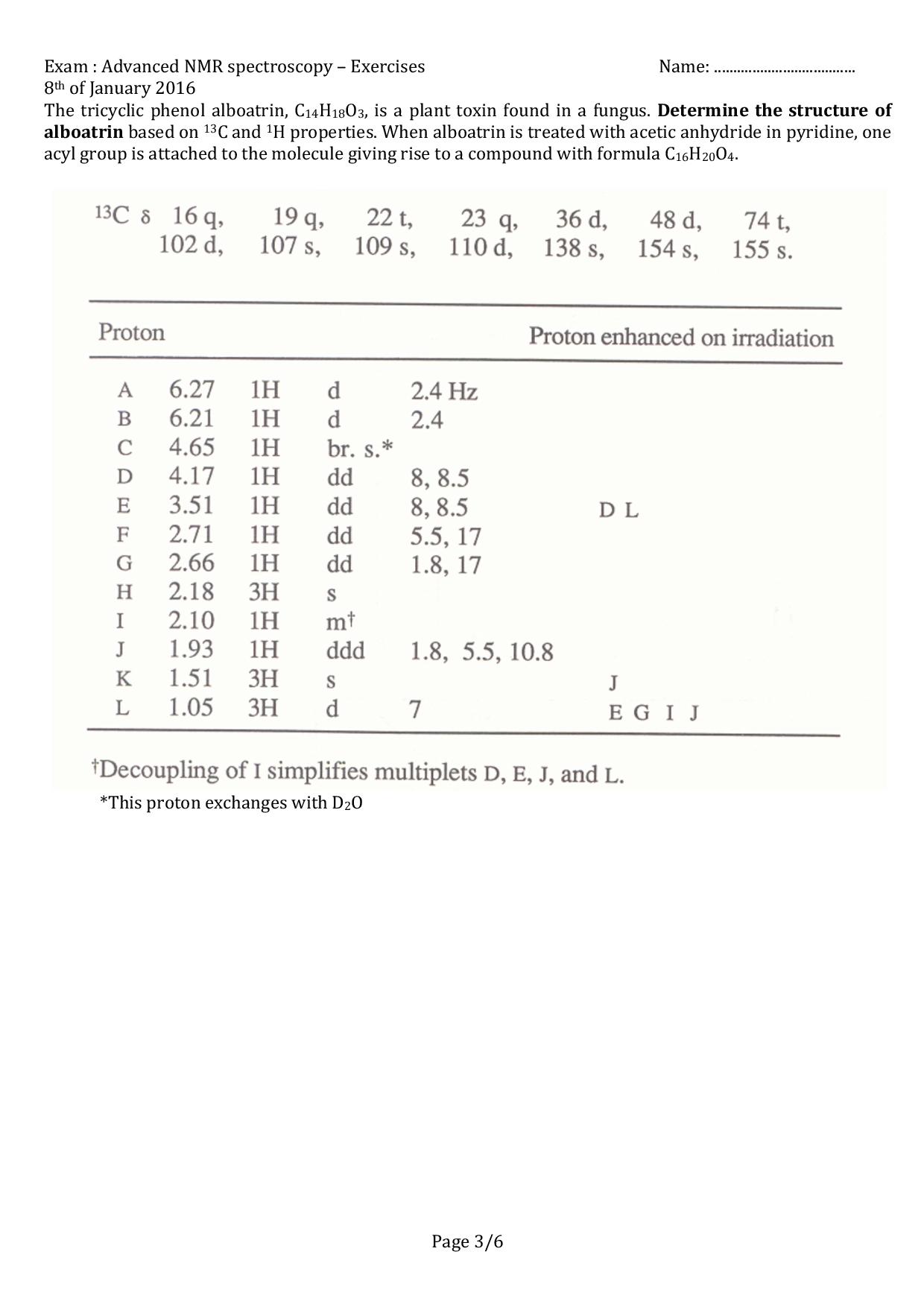
8 januari 2016
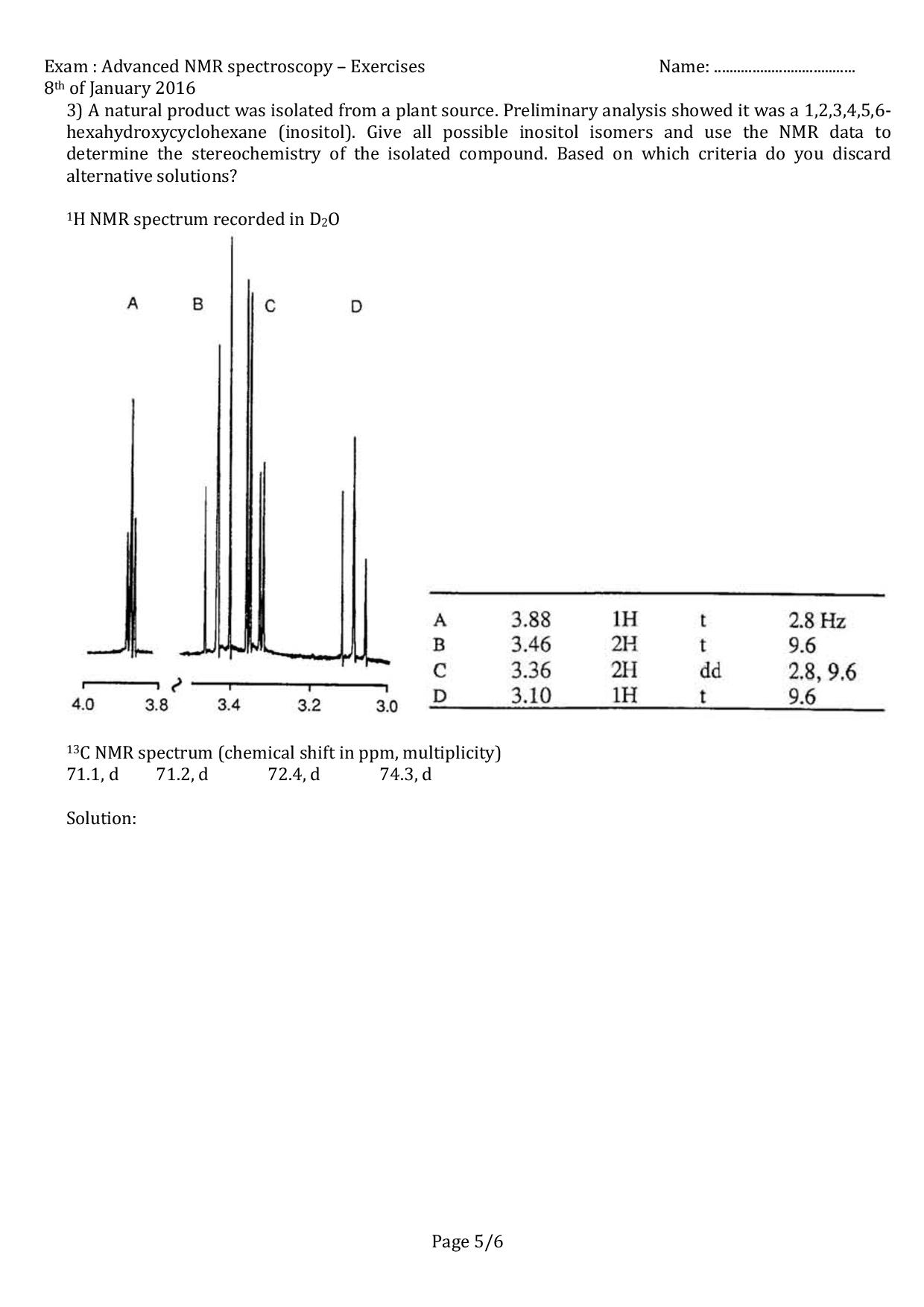
Media:Examen Advanced NMR 2016-page-001.jpg Media:Examen Advanced NMR 2016-page-002.jpg Media:Examen Advanced NMR 2016-page-003.jpg Media:Examen Advanced NMR 2016-page-005.jpg Media:Examen Advanced NMR 2016-page-007.jpg
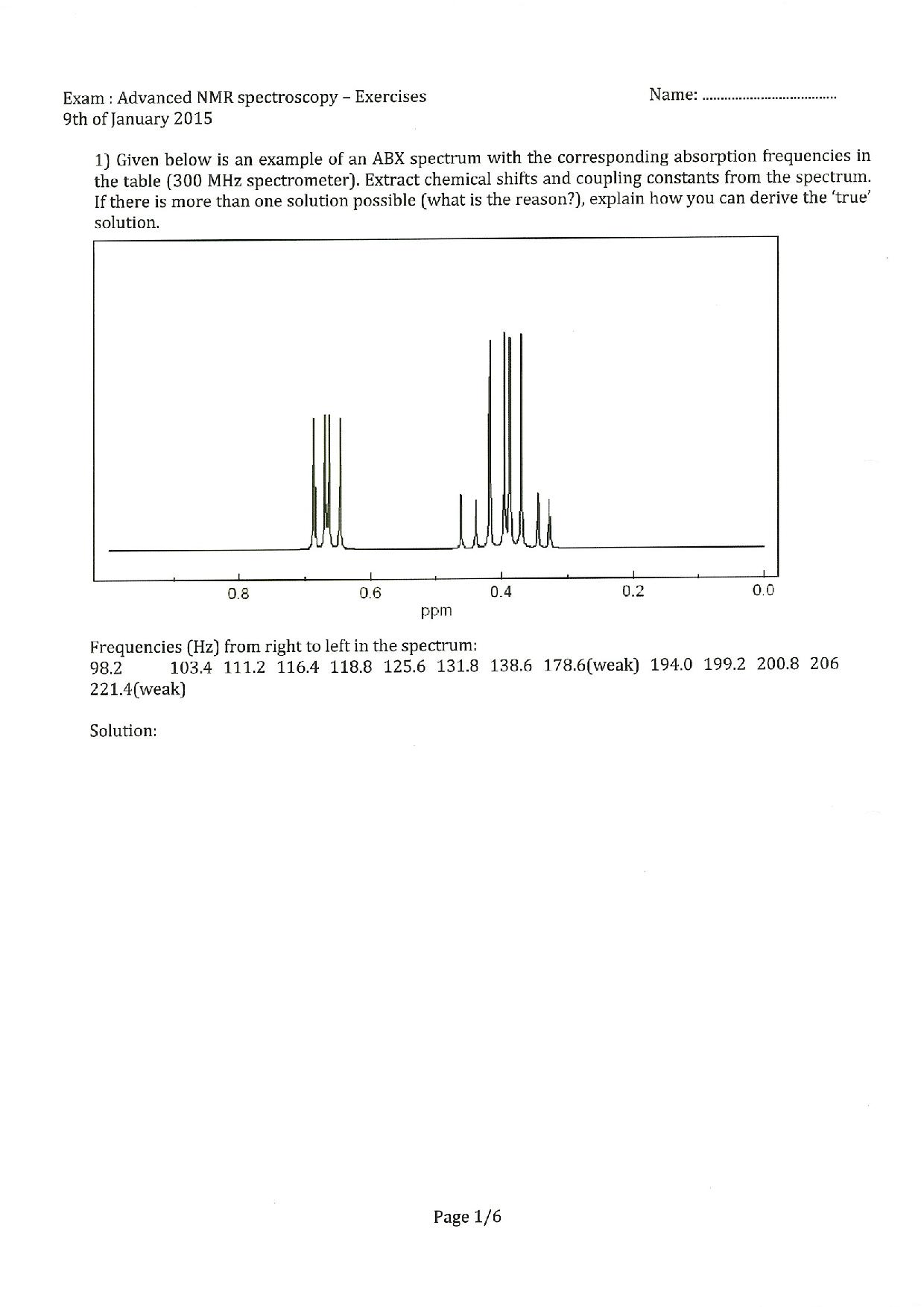
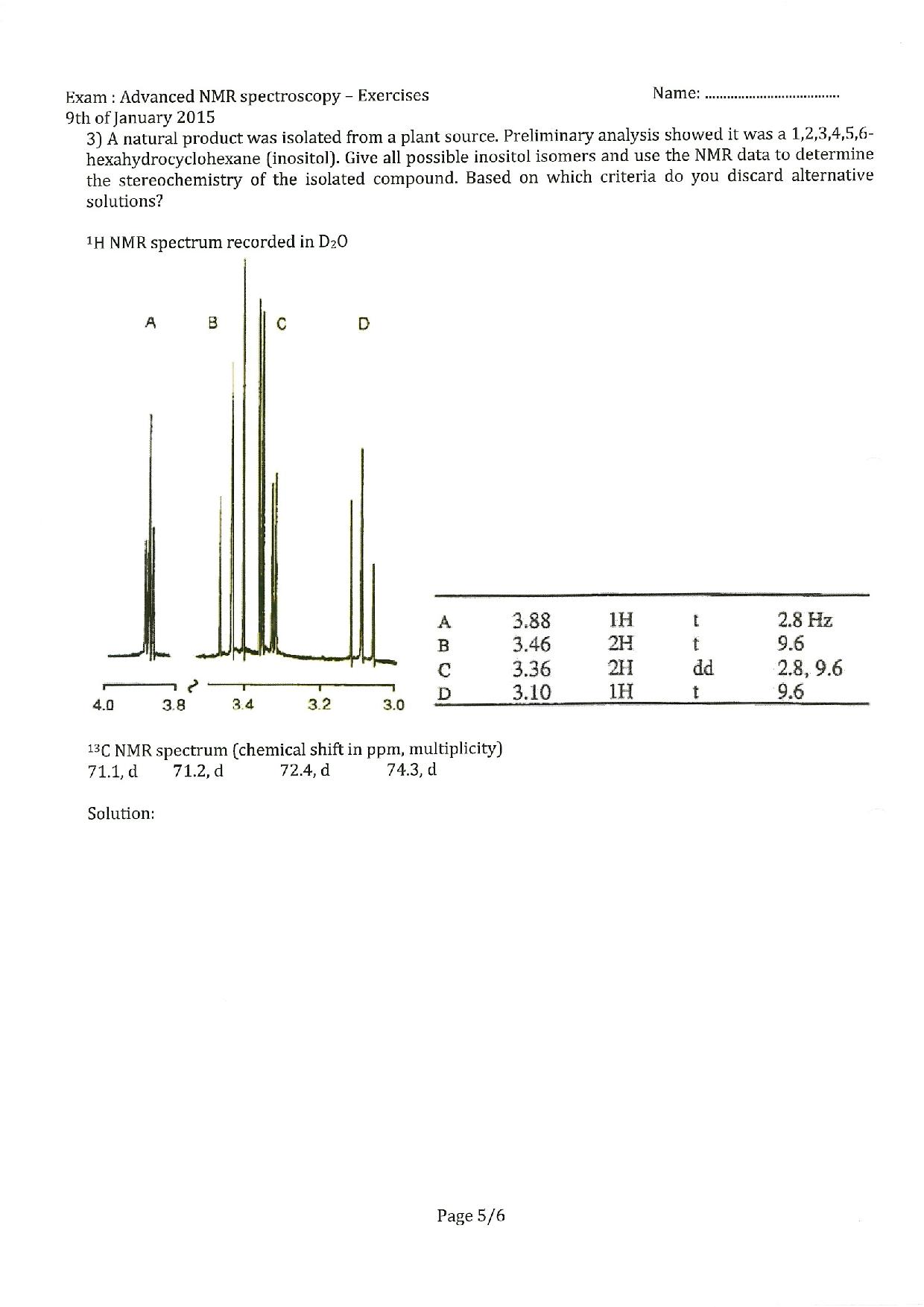
9 januari 2015
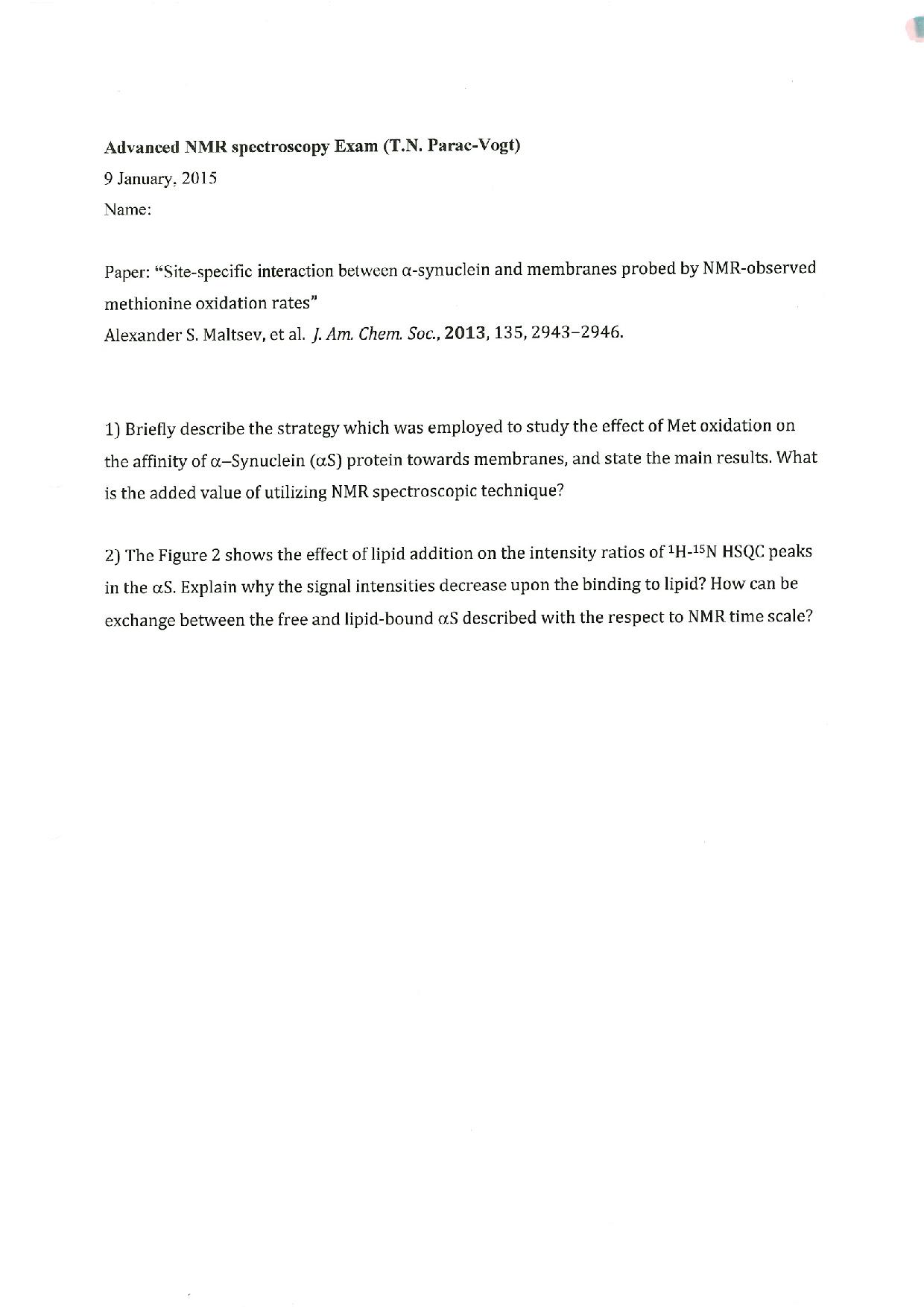
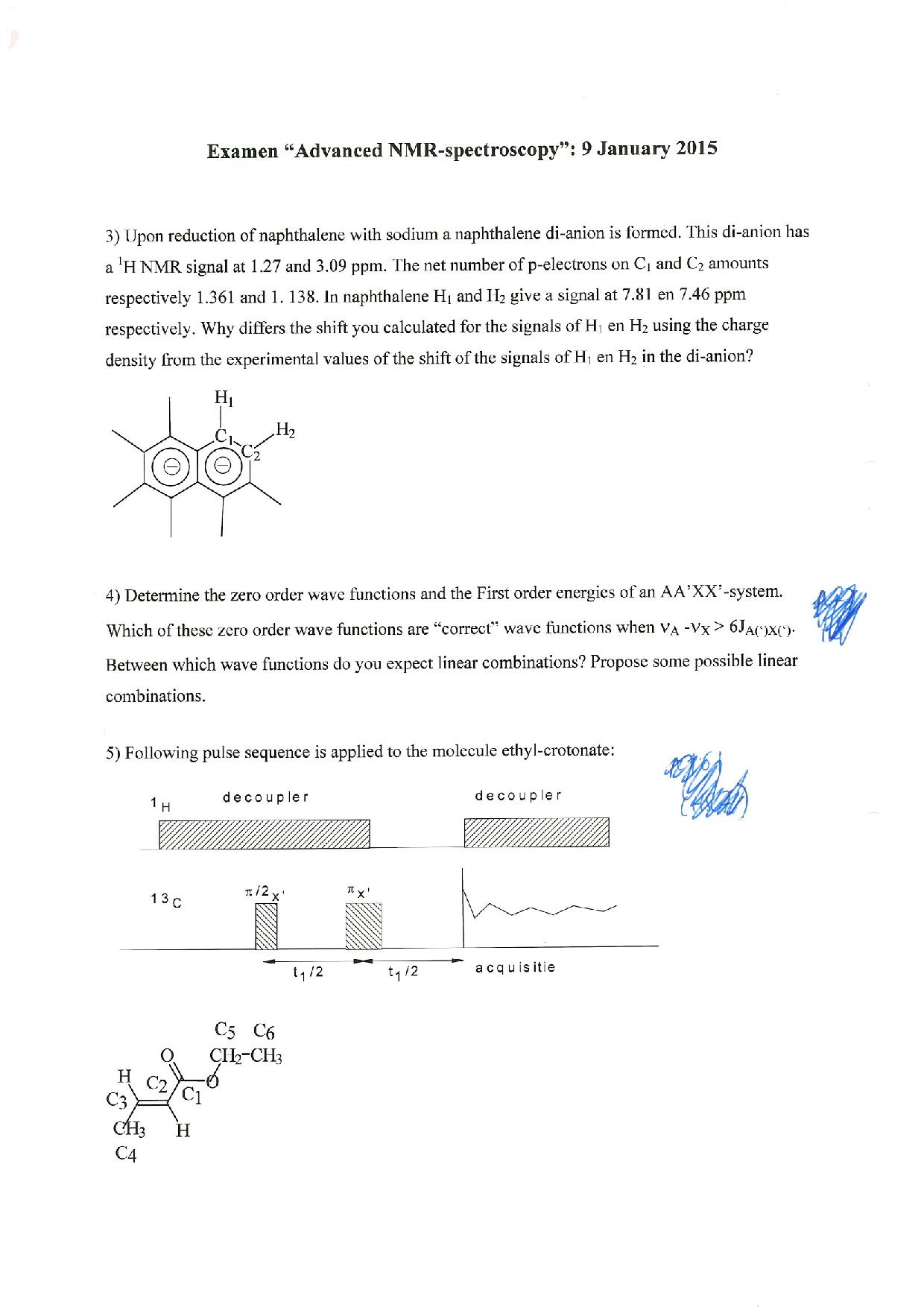
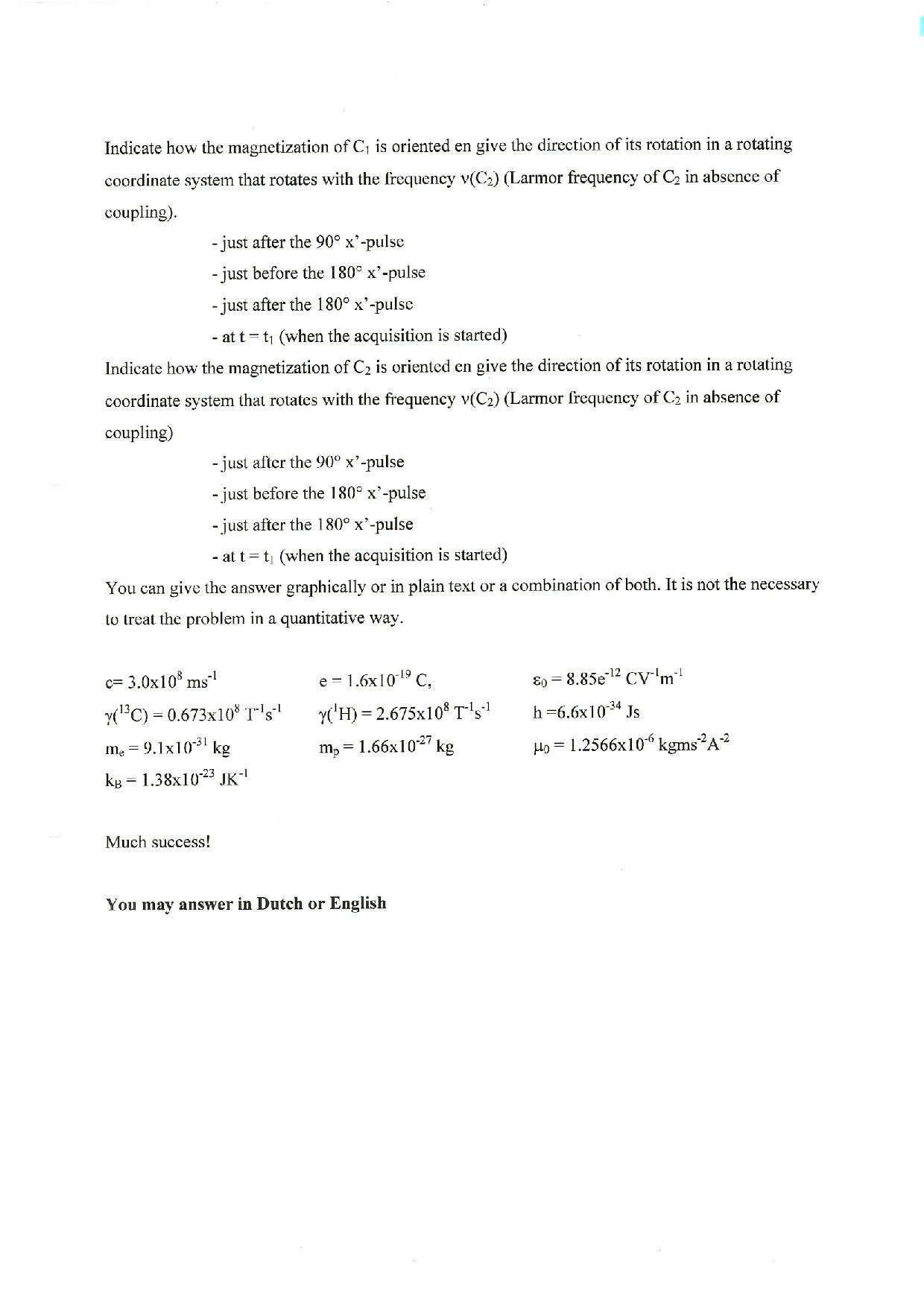
Media:Examen Advanced-NMR 2015-page-001.jpg Media:Examen Advanced-NMR 2015-page-002.jpg Media:Examen Advanced-NMR 2015-page-003.jpg Media:Examen Advanced-NMR 2015-page-004.jpg Media:Examen Advanced-NMR 2015-page-006.jpg Media:Examen Advanced-NMR 2015-page-008.jpg
13 januari 2012
Vogt
- Zowel GTP als de GTP-analogen GppNHp en GTPγS worden onderzocht. Wat is het verschil tussen GTP en deze analogen? Waarom worden de GTP-analogen in deze studie gebruikt?
- Leg de spectra in figuren 1B, 2A en 2B uit.
- Teken het Cu2+-cyclen en zeg hoe het interageert met GTP. Wat gebeurt er met de GTPÂ 31P-pieken bij interactie en waarom?
Van Der Auweraer
-
- Bereken de pi bijdrage in een 4J27 koppeling en in een 5J37 koppeling in een cycloheptatrieen (tekening met hoeken gegeven)
- Gegeven: vicinale koppelingsconstante is 2,8 Hz, en 2 structuren (1 met de 2 H's op een zesring en 1 met de 2 H's op een vierring). Met welke van de 2 structuren komt deze koppelingsconstante het beste overeen?
- Naar welke spin golffunctie evolueert een AX-systeem als er de Hartmann Hahn voorwaarden op toegepast worden?
- Puls sequentie: 13C: (pi/2)x' 1/J pix' 1/J FID; 1H: Ontkoppeling voor pi/2-puls op 13C en tijdens FID van 13C
- Hoe evolueert de magnetisatie van een 13C in een CH-groep in een assenstelsel dat roteert met de Larmorfrequentie van een 13C-kern zonder koppeling met 1H?
- Waarom volstaat het niet om na de pi/2-puls en evolutieperiode 1/J het FID te detecteren?
De Borggraeve (oefeningen en alleen schriftelijk)
- ABX spectrum van de 2e orde
- Van een bepaald molecule zijn 1H-spectrum en NOE-effecten gegeven. Bepaal zo goed als mogelijk welke pieken bij welke H's horen en welke configuratie het molecule heeft. Teken voor dit molecule ook een COSY- en TOCSY-spectrum.
25 januari 2010
Vogt
- Verklaar van waar de pieken komen en bespreek hun opsplitsing en multipliciteit.
-
- Welke argumenten gebruiken de auteurs om tot de voorgestelde configuraties te komen?
- Kan men onderscheid maken tussen de verschillende configuraties via NMR?
Van Der Auweraer
- Bereken de pi bijdrage in een 4J27 koppeling en in een 5J37 koppeling in een cyclohexatrieen
- Naar welke spin golffuncties gaat een AX-systeem als er de Hartmann Hahn voorwaarden op toegepast worden?
- Puls sequentie: pi/2x' t1/2 piy' t1/2 FID. Toepassen op een AX systeem met vx0= va0 + 2pi Jax en t1/2=1/8piJax. Bespreek en leg uit hoe het spectrum er nadien gaat uit zien.
De Borggraeve (oefeningen en alleen schriftelijk)
- ABX spectrum van de 2e orde
- Uitzoeken welke configuratie een bepaald molecule heeft adhv spectra.