Advanced Organic Chemistry: verschil tussen versies
Naar navigatie springen
Naar zoeken springen
| Regel 5: | Regel 5: | ||
[[Categorie:Machemie]] | [[Categorie:Machemie]] | ||
==28 januari 2013 NM== | ===28 januari 2013 NM=== | ||
#Explain the following reaction. [[Bestand:org1.png]] | #Explain the following reaction. [[Bestand:org1.png]] | ||
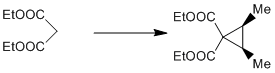
#How is given cyclopropane synthesized from diethyl malonate in several steps? Choose reagents such that a maximal yield is obtained. [[Bestand: | #How is given cyclopropane synthesized from diethyl malonate in several steps? Choose reagents such that a maximal yield is obtained. [[Bestand:org2.png]] | ||
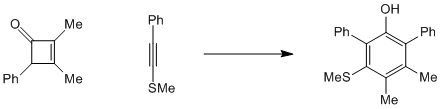
#This reaction scheme is an example of a benzannelation reaction. Upon heating, several consecutive steps happen so that the given end product is obtained. Among these steps are three electrocyclic reactions (two 4-electron and one 6-electron), a tautomerization, and a cycloaddition (not necessarily in this order). [[Bestand: | #This reaction scheme is an example of a benzannelation reaction. Upon heating, several consecutive steps happen so that the given end product is obtained. Among these steps are three electrocyclic reactions (two 4-electron and one 6-electron), a tautomerization, and a cycloaddition (not necessarily in this order). [[Bestand:org3.png]] | ||
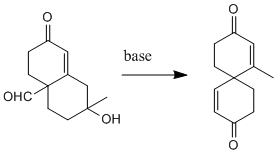
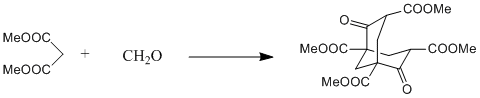
#Explain formation of this product in presence of base. [[Bestand: | #Explain formation of this product in presence of base. [[Bestand:org4.png]] | ||
#Give product A and explain how this reaction occurs. [[Bestand: | #Give product A and explain how this reaction occurs. [[Bestand:org5.png]] | ||
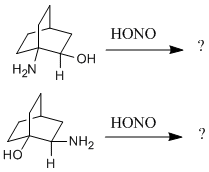
#What products will be formed in following reactions? [[Bestand: | #What products will be formed in following reactions? [[Bestand:org6.png]] | ||
Versie van 4 jan 2017 18:55
Examenvragen
28 januari 2013 NM
- Explain the following reaction.
- How is given cyclopropane synthesized from diethyl malonate in several steps? Choose reagents such that a maximal yield is obtained.
- This reaction scheme is an example of a benzannelation reaction. Upon heating, several consecutive steps happen so that the given end product is obtained. Among these steps are three electrocyclic reactions (two 4-electron and one 6-electron), a tautomerization, and a cycloaddition (not necessarily in this order).
- Explain formation of this product in presence of base.
- Give product A and explain how this reaction occurs.

- What products will be formed in following reactions?